Overview
As design lead for a global employee support transformation at EY, I partnered with a UX researcher to conduct a rigorous qualitative free text analysis — capturing how employees actually articulate their technology issues in their own words, and translating that into catalog naming guidelines and alias frameworks.
Process
Step 1 — Data collection & color coding
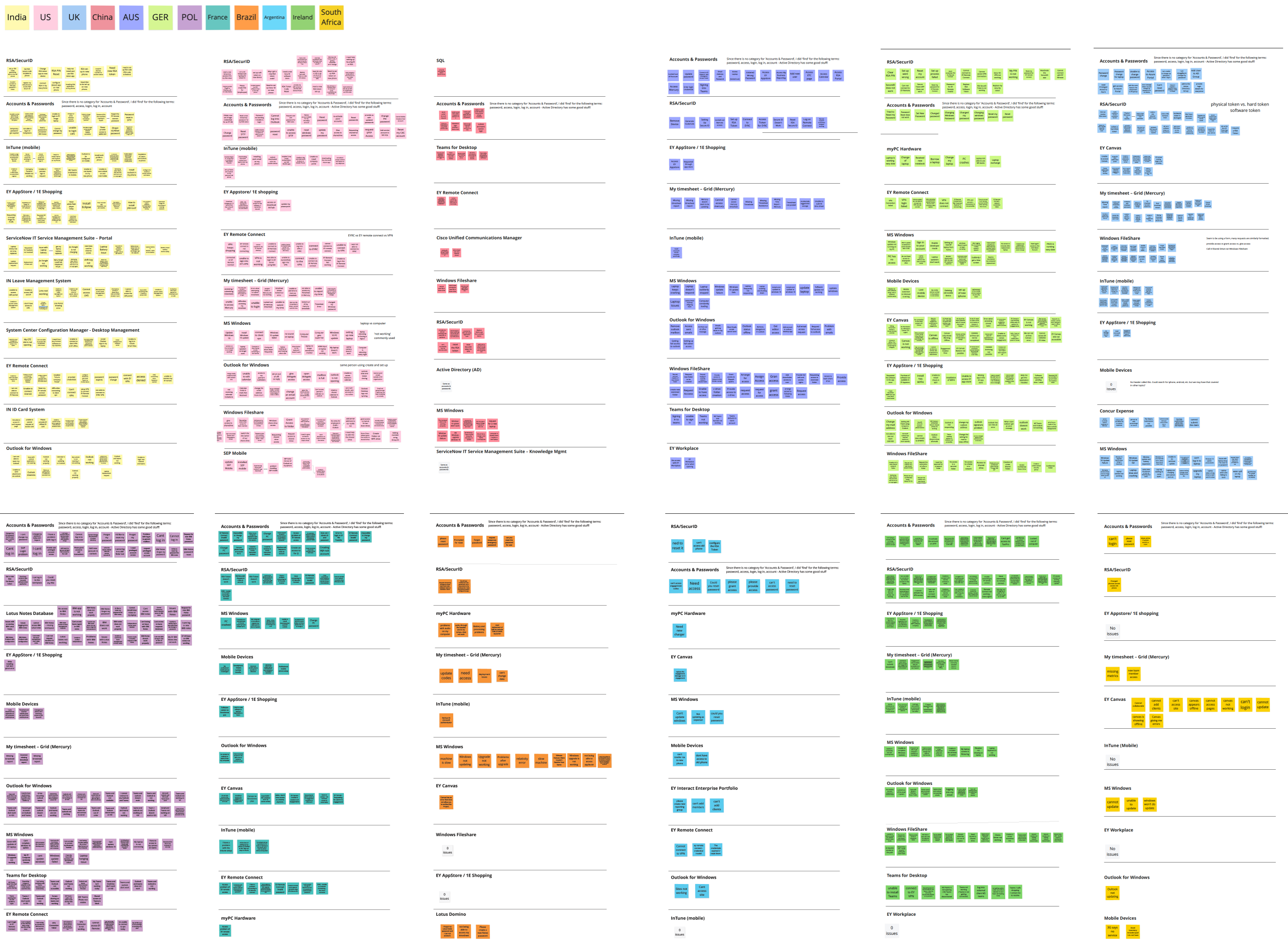
We collected free text from the top 10 highest-volume catalog item form submissions, categorising each by ticket category using distinct sticky note colors per country.
Step 2 — Clustering analysis
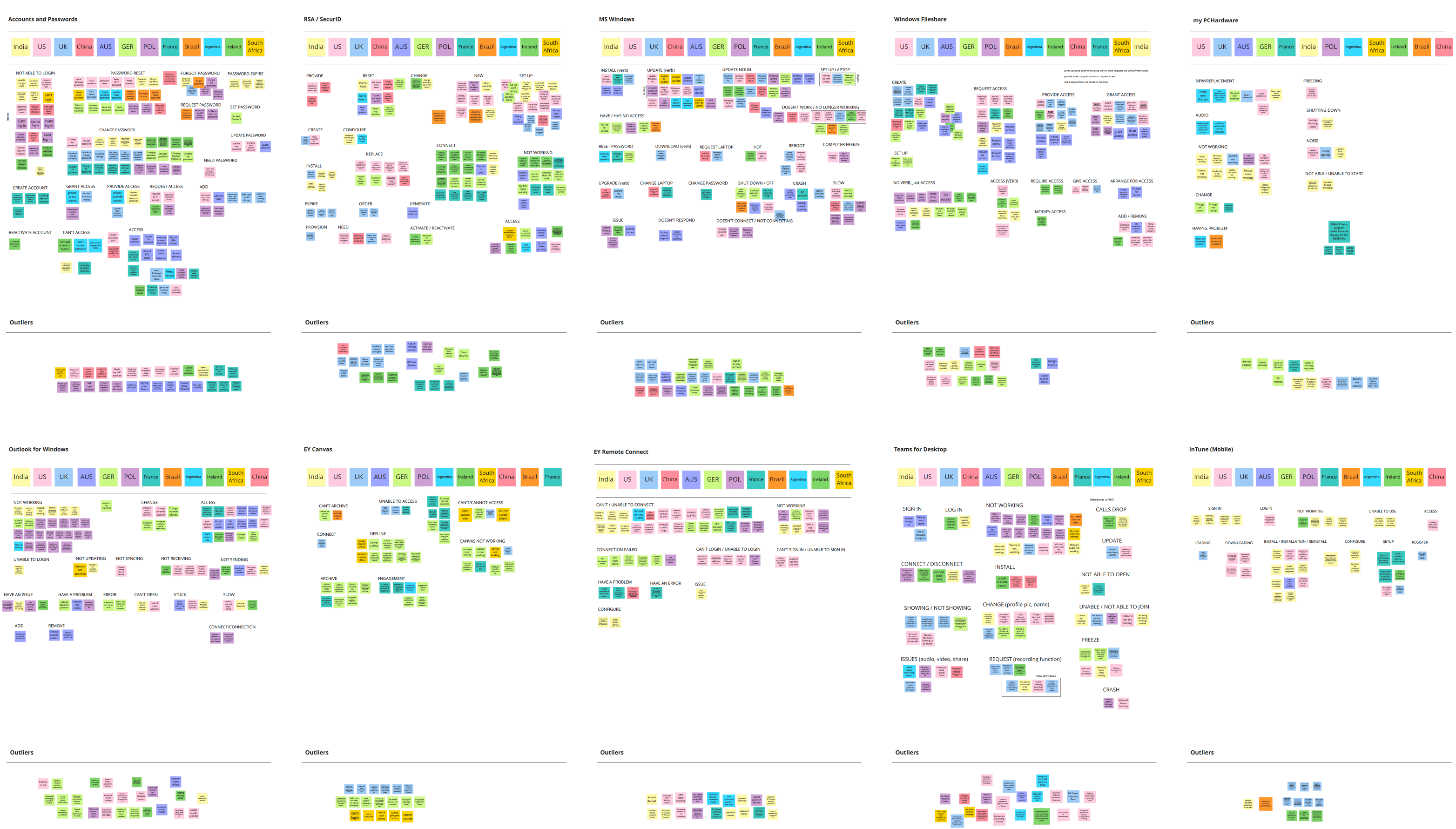
We organised color-coded stickies into ticket category boards and performed a clustering analysis — identifying patterns in users' language and regional vs global term usage.
Step 3 — Naming recommendations
"Laptop" was overwhelmingly the most common global term, informing alias terms to improve search result accuracy across the portal catalog.
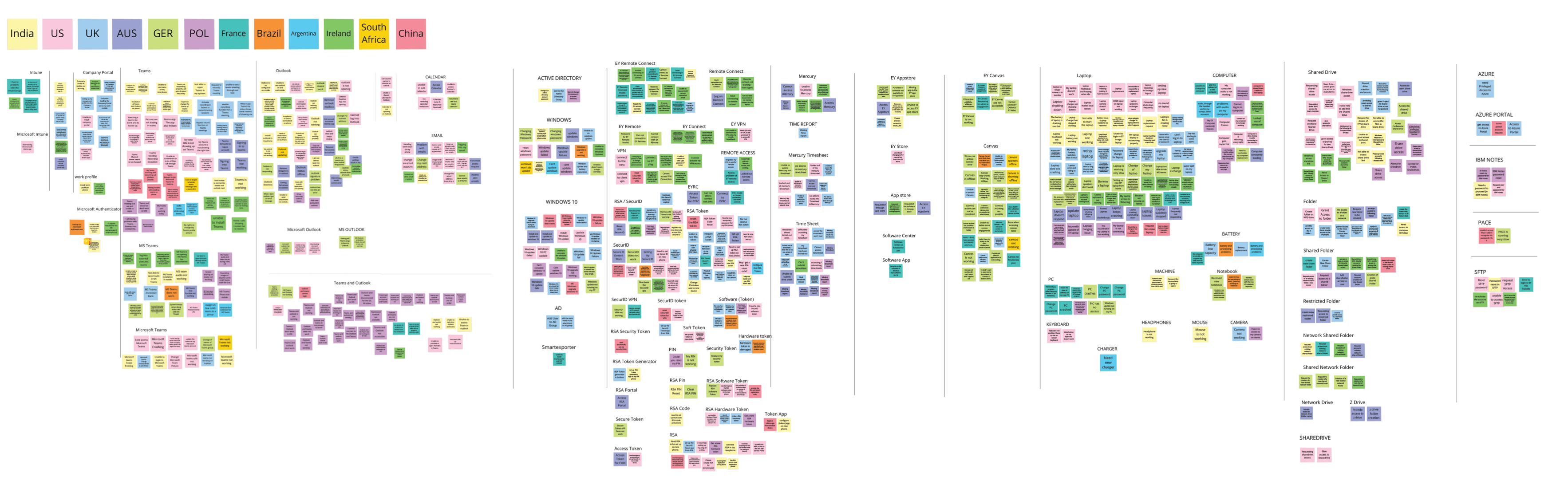
This human-led framework serves as a foundational dataset that AI-driven NLP algorithms can integrate — enabling faster extraction of insights with nuanced user context.
Key insights
Teams & Outlook
Users referred to products by shortened names and functional terms ("Email," "Calendar") — these became priority keywords and bot training candidates.
"Laptop" dominates globally
Users also referenced specific components (battery, keyboard, camera) — providing opportunities for more targeted catalog items.
VPN is essential
"VPN" emerged as a critical keyword particularly for India, USA, and China — with high variation in how users described EY's remote connection software.